// Time-Series Forecasting

City-Scale Water Demand Forecasting

We built a 24-hour municipal water demand forecast that combines historical consumption with external signals - weather, holidays, and public events - to keep dispatchers ahead of peaks and shortages.

offices

Poland

size

60-200 employees

industry

Government

revenue

Non-profit org

// Outcomes

The numbers that matter

  • 24h

    ahead-of-time forecast horizon

  • 90%

    prediction interval coverage

  • Real-time

    ingest of weather and event signals

01 · Water security

The Challenge

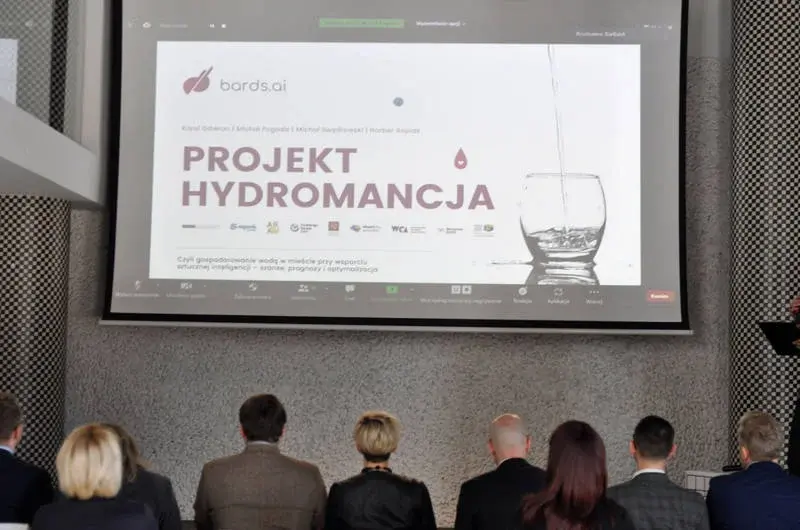
Supplying municipal water you can't afford to make a mistake - a shortage of water for some city institutions can have dire consequences. The inertia of the water supply system is high - as a result, you can't react quickly if a mistake is made. That's why predicting demand and the state of the water supply network can prove to be a key support in effective urban water management.

Water security isn't only a matter of having enough water. It is also about having enough water of sufficient quality for all of the myriad ways we use water - to drink, bathe, clean, produce energy, build things, and make food.

02 · Scope of work

NO TIME TO WASTE

Our goal was to create dashboard providing data-driven insights for station dispatchers

Step 1: Problem analysis: Exploratory analysis of the received data, projecting data-flow, identification of additional data sources and crystallization of the technical implementation of the business process

Step 2: PoC R&D: Building predictive models for inference values every 10min in span of 24h. For the purpose of PoC implementation, the problem has been simplified.

Step 3: Project closure: Development of a complete tool in the form of a display, containing the desired indicators and a set of charts representing the predictions of the developed models. Implementation based on Docker containers and REST interface.

03 · Challenges

WE LOVIN' IT

Absorb domain knowledge: The field of urban water management is an extremely specific field with its own unique data characteristics. Part of our work was to learn about the nature of the processes and extract knowledge from experts.

Enriching time series prediction with additional variables: The values of pressure and flow of water are continuously read by sensors monitoring the city's water supply, thus we can consider the problem of predicting successive values as a time-series prediction. In order to improve the quality of the model, it was also provided with external data, which may affect the city's water resources management such as the weather or ongoing mass events.

Conformal prediction: Not only did we provide detailed information about water supply indicators but also showed how certain the model is. Confidence intervals were added to charts allowing quick identification of areas where the model lacked confidence.

Anomaly studies: The system for delivering water to residents is crucial, and absolutely no one can afford failures. Therefore, we have built a system that detects detections based on time-series data.

// Expert insight

Engineers at bards.ai work mainly on commercial projects. In this project, we enjoyed the fact that we could not only test our knowledge, but also apply it to something that is useful to hundreds of thousands of people every day.
Michal Pogoda

Michal Pogoda

Co-founder at bards.ai

// Ready to ship?

Let's build something that delivers numbers like these.

Book a meeting